Premier & World Series
1 day ago
Mr Vegas Grand Slam of Darts - Stats Special
Premier & World Series
|
1 day ago
WOLVERHAMPTON WONDERS
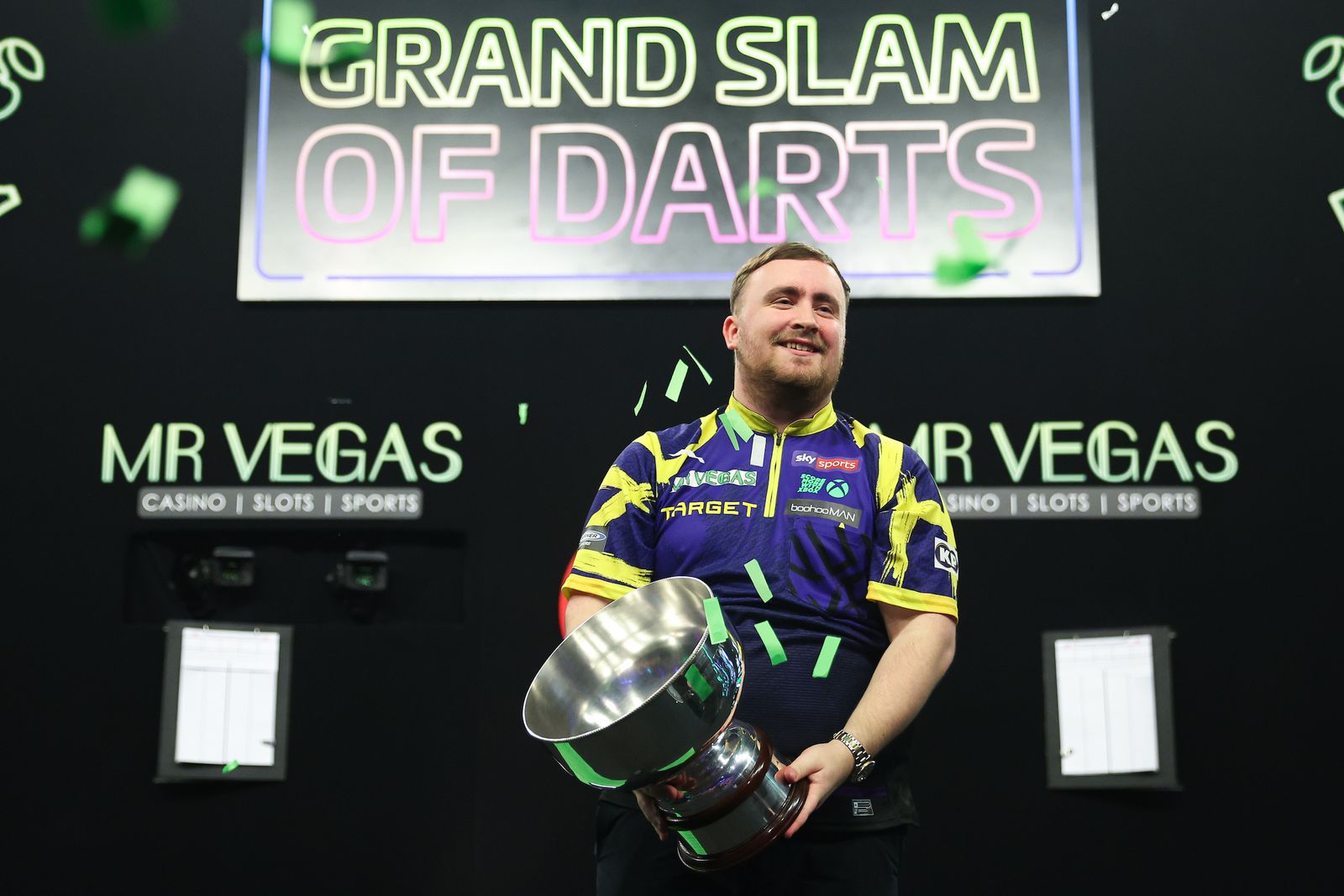
In November 2007, at the Wolverhampton Civic Hall, a brand-new tournament concept from the Professional Darts Corporation and ITV Sport saw the best players from the British Darts Organisation invited to compete alongside PDC stars in the inaugural Grand Slam of Darts.
It showcased the likes of established greats Phil Taylor, Raymond van Barneveld and John Part taking on BDO rivals Gary Anderson, Mark Webster and Scott Waites, with the sport’s brightest young talents, James Wade, Michael van Gerwen and Adrian Lewis, up against darting icons Dennis Priestley, Wayne Mardle and Chris Mason!
In what turned out to be the first in a long line of semi-final classics, Phil Taylor overcame Gary Anderson 13-11 on his way to lifting the first Grand Slam trophy.
Through the years, the tournament has provided some truly memorable moments during the cross-code era, including Scott Waites’ sensational comeback from 8-0 down to topple James Wade 16-12 in the 2010 final, Martin Adams’ long-awaited appearance and Andy Fordham’s return to the big stage, which began with that “dream” 180 in 2015!
There was also the first victory by a woman at the Grand Slam, courtesy of Anastasia Dobromyslova (defeating Vincent van der Voort in 2009), and Fallon Sherrock’s unforgettable match-winning 170 checkout on her way to reaching the quarter-finals in 2021.
Having won a group match in each of the last three years, Beau Greaves will look to progress through the group of death against Luke Littler and Niels Zonneveld at WV Active Aldersley in 2026.
We’ve also been treated to seven nine-dart finishes in the Grand Slam of Darts.
2008 – James Wade (lost to Gary Anderson 10-8, R2)
2014 – Kim Huybrechts (beat Michael van Gerwen 16-10, QF)
2015 – Dave Chisnall (beat Peter Wright 5-2, R1)
2018 – Dimitri Van den Bergh (beat Stephen Bunting 10-6, R2)
2022 – Josh Rock (lost to Michael van Gerwen 10-8, R2)
2023 – Ryan Searle (beat Nathan Rafferty 5-3, R1)
2025 – Luke Humphries (beat Michael Smith 5-3, R1)
GROUP-STAGE SHOOT-OUTS & STATISTICS!
A unique feature of the Grand Slam of Darts is its first-round group stage, providing us with 48 matches played over the best of nine legs, with plenty of precarious permutations.
Across the 19 previous editions of the tournament, in which the field was drawn into eight groups of four, we have seen 13 players progress in second place despite winning only one match. Conversely, 19 players were eliminated in third place despite winning two matches, including Wes Newton on two occasions (2008/2013).
Both Mark Webster (2008/2010) and Steve Lennon (2017/2019) progressed through the group stage with just one win, only to suffer elimination with two wins, two years later.
During the early years of the Grand Slam, a nine-dart shoot-out would come into play for players tied in second place. Once again, Mark Webster found himself on both sides of the equation, progressing on one occasion and suffering elimination on another, as did Andy Hamilton.
2008 – Andy Hamilton 265-169 Alan Tabern
2009 – James Wade 361-277 Andy Hamilton
2013 – Mark Webster 272-199 Wes Newton
2016 – Robert Thornton 345-340 Dimitri Van den Bergh
2017 – Darren Webster 301-298 Mark Webster
Only eight players have lost out in the group stage despite winning their opening two matches, including defending champion Raymond van Barneveld in 2013 and reigning World Champions Peter Wright in 2022 and Michael Smith in 2023.
Conversely, just two players progressed despite losing their opening two matches, both doing so at the only Grand Slam held behind closed doors, in Coventry in 2020: Adam Hunt and Ian White. Hunt is also part of an exclusive club of just four players to have lost their opening match 5-0 yet still qualified from the group stage.
NEW FORMAT – OLD RECORDS
The Grand Slam of Darts first-round group phase has a new look in 2026, with the field increasing from 32 to 48 players, split into 16 groups of three. Matches remain the best of nine legs, with certain players looking to extend winning records or end losing streaks in the group stage.
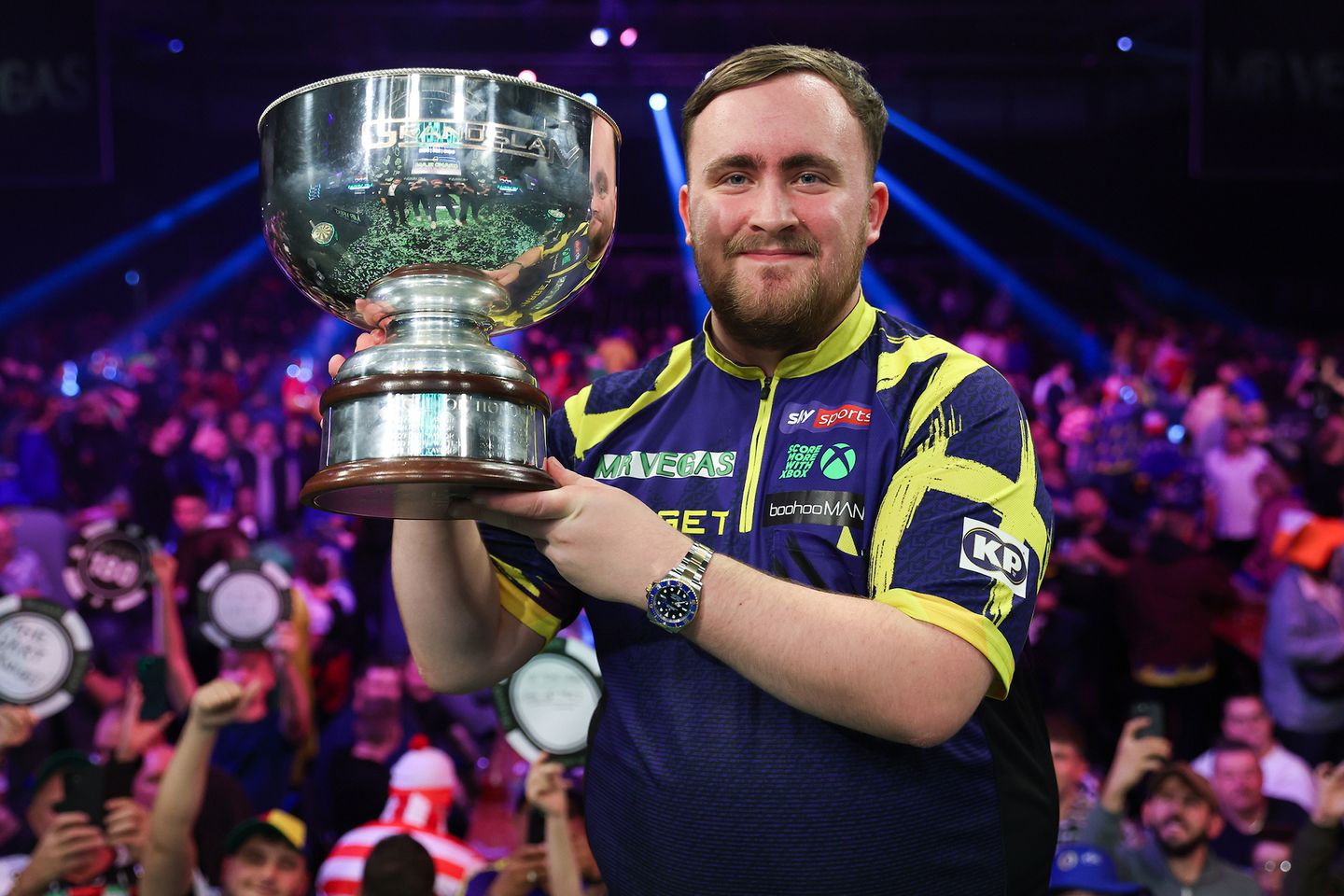
Defending back-to-back champion Luke Littler is yet to taste defeat in Wolverhampton and will hope to extend his unbeaten record in the group stage (and beyond) in 2026. Only Stephen Bunting (2014/2017/2018) has previously remained unbeaten in the group phase across his first three Grand Slam appearances.
Former champions Phil Taylor (27/33, 82%) and Michael Smith (29/36, 81%) lead the way overall in terms of group-stage match-winning percentages, with Taylor progressing on each of his 11 Grand Slam appearances.
Meanwhile, Gary Anderson established an incredible record from his debut in 2007, progressing to the knockout stage for 17 consecutive years (having missed only the 2022 event), before suffering group-stage elimination for the first time in 2025. Rob Cross will now hope to maintain his own impressive run, having progressed from his group in each of his previous eight appearances (2017-2024).
With 18 appearances and 54 group matches apiece, Gary Anderson and Michael van Gerwen lead the way with 41 group-stage victories each, just ahead of James Wade on 40. Both van Gerwen and Wade return for a record 19th appearance and will look to add to their winning tallies in 2026.
Van Gerwen also holds the record of 20 consecutive group-match victories, stretching from his final group match in 2011 to his opening group match in 2018. With the new format now in place, Luke Littler would have to remain unbeaten in the group phase until 2033 to surpass that record!
As far as losing streaks are concerned, Lisa Ashton will be looking to end an unwanted run of 15 consecutive defeats at the Grand Slam of Darts. In 2026, she will hope to reach the knockout phase at the sixth time of asking, just as Martin Schindler did in 2025 after failing on his first five attempts.
Vincent van der Voort remains the only player to have made seven Grand Slam appearances without progressing beyond the group stage, despite winning six matches along the way.
KEEPING UP APPEARANCES
As we celebrate the 20th edition of the Grand Slam of Darts, Michael van Gerwen (absent only in 2009) and James Wade (absent only in 2022) lead the way, each making their 19th appearance in 2026, while Gary Anderson will be missing for only the second time (having also missed 2022).
With an additional 16 places available as the field increases from 32 to 48, it seems quite appropriate that 16 players will make their Grand Slam debuts in 2026, bringing the total number of participants since 2007 to 201.
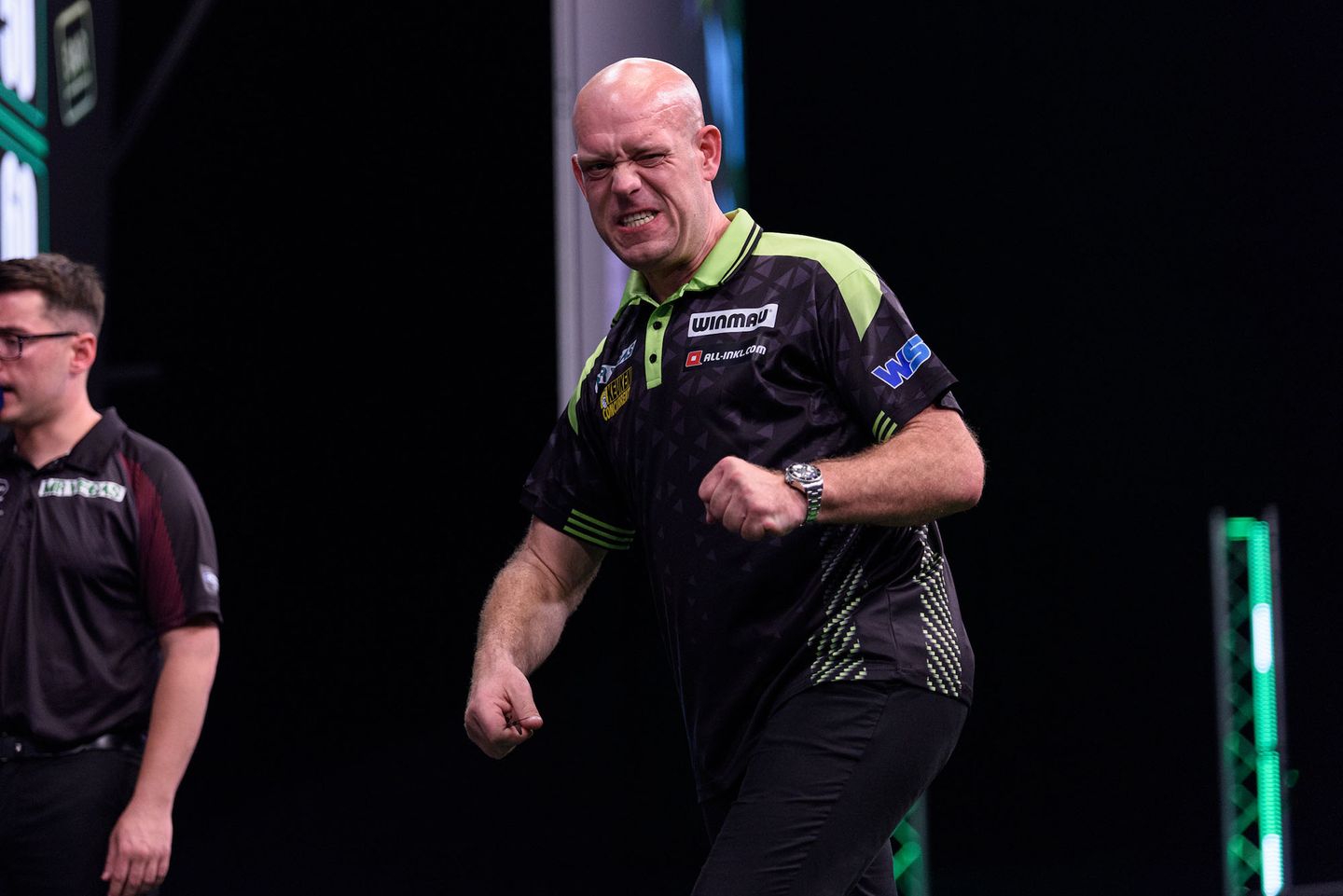
Players from a record 13 different nations will feature this year, including two from Sweden (Jeffrey de Graaf and Anton Östlund), marking the country's first representation since Magnus Caris competed in 2011. We will also see a record 23 English, seven Dutch and four German players, while Poland will have two representatives for the first time, with Sebastian Białecki joining Krzysztof Ratajski.
The Grand Slam has produced nine different champions, with five Englishmen, two Dutchmen and a Welshman lifting the trophy, not forgetting Portuguese trailblazer José de Sousa’s famous victory when the tournament was “sent to Coventry” in 2020.
The runners-up have only ever been English (12), Dutch (Michael van Gerwen in 2012) or Scottish (Peter Wright three times, Gary Anderson twice and Robert Thornton once).
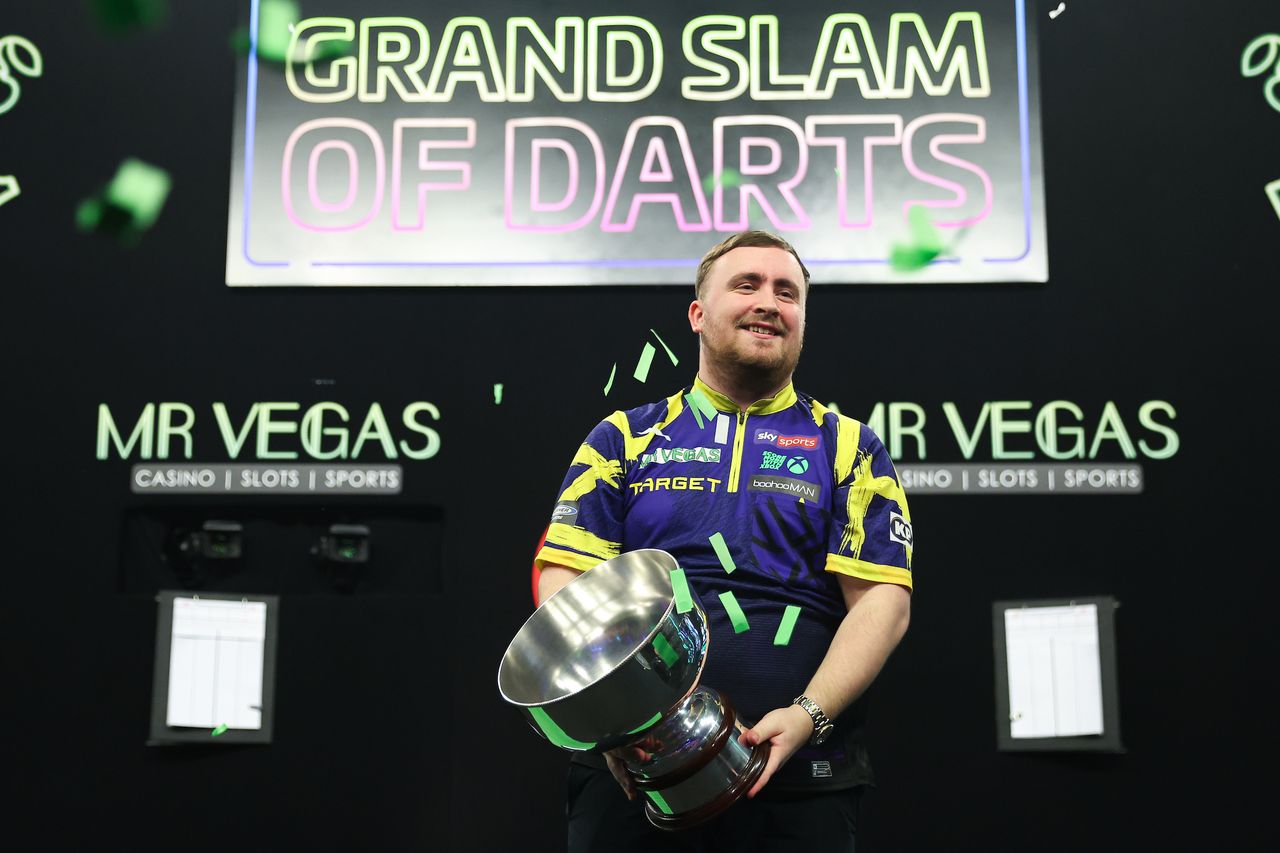
Luke Littler’s victory in 2024 saw him join Taylor (winner of the inaugural event in 2007) and de Sousa (2020) as Grand Slam champions on debut. His successful title defence in 2025 placed him alongside Phil Taylor, Michael van Gerwen and Gerwyn Price as one of just four players to have retained the title.
A third consecutive triumph for Littler (2024-2026) would see him emulate Taylor (2007-2009) and van Gerwen (2015-2017) in securing a hat-trick of successive victories, while Price also lifted the trophy three times in four years (2018/19/21).
In each of the past four years, the player who lifted the Eric Bristow Trophy in Wolverhampton has gone on to claim the Sid Waddell Trophy at Alexandra Palace. Phil Taylor was the first to achieve this double in 2008/09 and again in 2009/10, followed by Michael van Gerwen in 2016/17.
The latest run began with Michael Smith in 2022/23, followed by Luke Humphries in 2023/24 and Luke Littler in both 2024/25 and 2025/26.
However, both Smith’s and Humphries’ Grand Slam title defences ended in the first-round group stage the following year. Previously, only Scott Waites (2011) and Raymond van Barneveld (2013) had failed to progress from their groups as defending champion.
ALL THE WAY IN WOLVERHAMPTON
Despite the changes to the group format in 2026, the Grand Slam of Darts knockout phase retains its long-established format of best of 19 legs in the second round, increasing to best of 31 legs from the quarter-finals onwards.
This will be the thirteenth edition of the Grand Slam in which the tournament schedule features two quarter-finals on both Friday and Saturday evenings, followed by the semi-finals on Sunday afternoon and the final on Sunday evening.
A commonly pondered question is whether there is an advantage to playing in the first or second semi-final. The statistics suggest not, with six champions emerging from the first semi-final and six from the second across the previous 12 editions played under the current scheduling.
In the latter stages, we have been treated to eight quarter-finals and four semi-finals finishing with a 16-15 scoreline. Gary Anderson has been on the wrong end of three marathon matches, losing to Wolverhampton’s own Wayne Jones (QF 2010), fellow Scottish legend Peter Wright (SF 2017) and Luke Littler in an all-time classic (SF 2024).
James Wade, meanwhile, has won all three 31-leg thrillers that he has contested, defeating Terry Jenkins (QF 2010), Dimitri Van den Bergh (SF 2020) and Josh Rock (QF 2023). We are yet to see a final go the full distance (the closest being van Barneveld’s 16-14 victory over van Gerwen in 2012). Maybe 2026 will be the year for the grandest of finales?
RELATED NEWS







Title Sponsors










Partners